Reaching 55 is a significant milestone, bringing you closer to retirement. Here’s what you should know about your Central Provident Fund (CPF) to help you plan better. Six months before your 55th birthday, you’ll receive a letter from the CPF Board. You can then apply to withdraw your CPF savings online.
Withdrawing savings is optional, and it’s important to understand both the pros and cons before making a decision. 👇
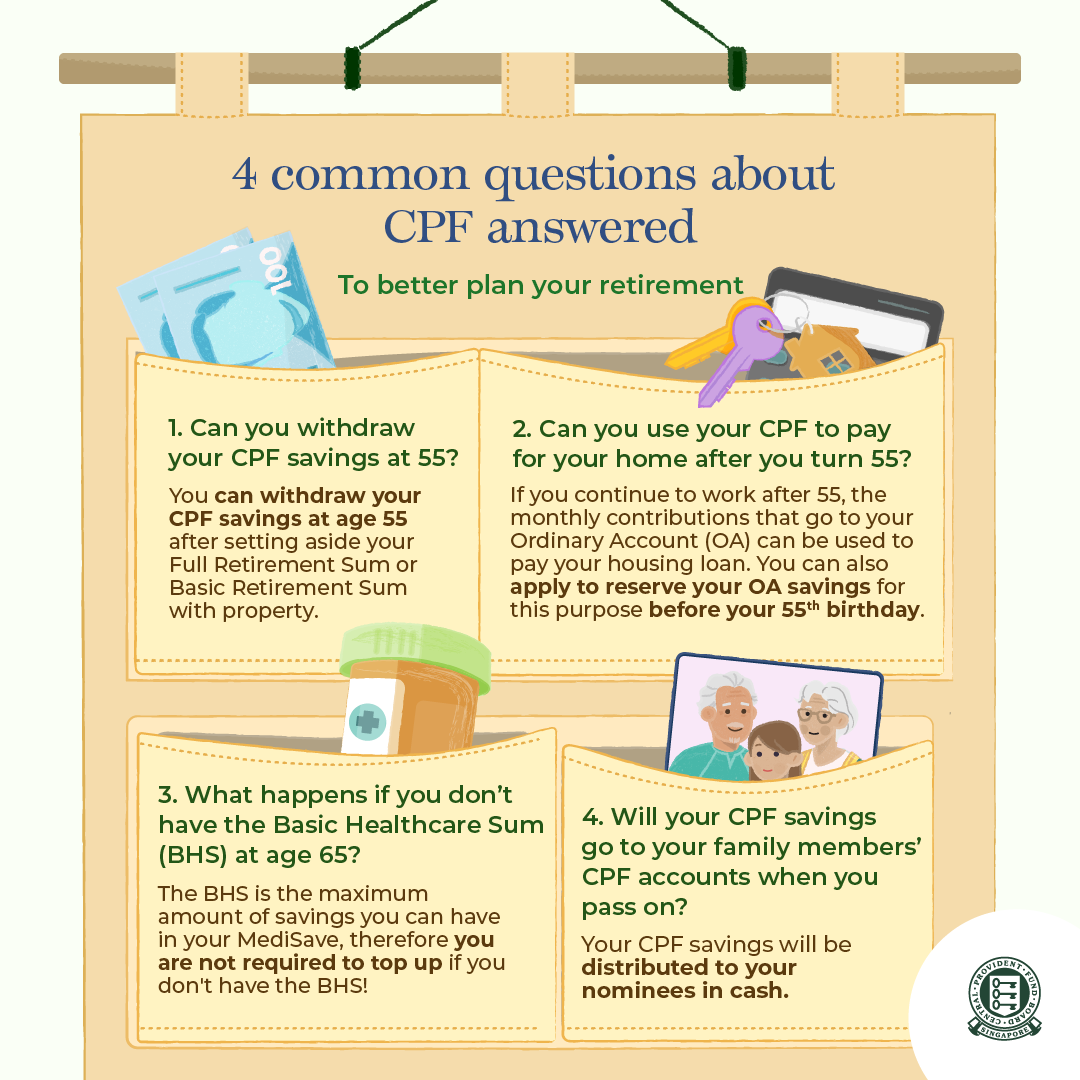
Retirement Account (RA) Created at Age 55 🎉
Your CPF plays a crucial role in securing your future by building retirement savings and supporting your basic housing and healthcare needs. Your CPF savings have grown steadily since you started working, and turning 55 brings new decisions to consider.
From age 55:
- Your Retirement Account (RA) is automatically created. Savings from your Special Account (SA) and Ordinary Account (OA) will be auto-transferred to your RA, up to your Full Retirement Sum (FRS). SA savings are transferred first, followed by OA savings.
- For higher payouts in retirement, you can top up your RA to the Enhanced Retirement Sum (ERS), which is 2x the FRS amount.
If your RA savings are insufficient to meet the FRS and you’ve used CPF for property, the amount withdrawn for your property (including accrued interest) will be used to meet the FRS. When you sell your property, you’ll need to restore your RA up to your FRS with the sales proceeds.
Topping up your RA to the FRS is not mandatory if you are unable to, but it can lead to higher monthly payouts. You also enjoy tax relief for cash top-ups up to the FRS.
These RA funds will compound for the next 10 years, contributing to the CPF LIFE scheme when you turn 65 (or latest, by age 70). CPF LIFE, a national annuity scheme, provides a monthly payout for as long as you live. Higher amounts set aside in your RA result in higher payouts. 📈
Fulfilling Your Retirement Sum 🎯
Planning for retirement is simplified with the Basic Retirement Sum (BRS), Full Retirement Sum (FRS), and Enhanced Retirement Sum (ERS). These sums guide the CPF savings you need for your desired monthly payouts in retirement.
- The BRS covers basic living needs in retirement, excluding rental expenses.
- The FRS is two times the BRS, offering higher monthly payouts that include rental expenses. This is why your CPF savings up to your FRS are set aside in your RA at age 55.
- If you own a property in Singapore with a remaining lease lasting until you are 95 or older, you can meet your FRS with a mix of property (up to half your FRS) and cash. You can then apply to withdraw part of your RA savings down to your BRS using your property.
- For even higher payouts, you can top up your RA to the current ERS. The ERS is 3 times the BRS and increases annually to provide for those seeking greater payouts.
The CPF Board adjusts the BRS, FRS, and ERS annually based on long-term inflation and rising living standards. While predicting the future is impossible, historical data shows a consistent increase.
From 2023 to 2027, the Retirement Sums are projected to increase by 3.5% per year. You can use this figure for your calculations, keeping in mind that future changes might occur based on Singapore’s financial landscape.
| Year (If you turn 55 in this year…) | Basic Retirement Sum | Full Retirement Sum | Enhanced Retirement Sum |
|---|---|---|---|
| 2017 | $83,000 | $166,000 | $249,000 |
| 2018 | $85,500 | $171,000 | $256,500 |
| 2019 | $88,000 | $176,000 | $264,000 |
| 2020 | $90,500 | $181,000 | $271,500 |
| 2021 | $93,000 | $186,000 | $279,000 |
| 2022 | $96,000 | $192,000 | $288,000 |
| 2023 | $99,400 | $198,800 | $298,200 |
| 2024 | $102,900 | $205,800 | $308,700 |
| 2025 | $106,500 | $213,000 | $319,500 |
| 2026 | $110,200 | $220,400 | $330,600 |
| 2027 | $114,100 | $228,200 | $342,300 |
What Interest Can You Earn with CPF? 💰
If you choose to keep your savings in your CPF accounts, you can earn three types of interest rates: CPF interest rates, Extra interest rates, and Additional Extra interest rates.
Interest rates for your respective CPF accounts are:
- OA: 2.5% p.a.
- SA: 4% p.a.
- RA: 4% p.a.
Once funds are transferred to your Retirement Account, they compound for 10 years before you can enter the CPF LIFE scheme to start monthly payouts (typically between age 65 and 70). During this period, your funds in your Retirement Account continue to earn annual interest.
| Retirement Account Balances | Interest Returns (per annum) |
|---|---|
| First $30,000 | 6.0% |
| Next $30,000 | 5.0% |
| Remaining balances | 4.0% |
If you don’t have an immediate need for the money, leaving it in CPF allows you to continue enjoying a risk-free interest rate of at least 2.5% (OA). Proper planning is essential before withdrawing your CPF savings to avoid unnecessary expenditure of your retirement funds. 💡
Can I Withdraw? How Much and How Frequently? 🤔
The amount you can withdraw depends on your CPF Ordinary Account (OA), Special Account (SA), and Retirement Account (RA balances, and if they meet the current Full Retirement Sum (FRS). If you own a property with a lease valid until you turn 95 years old (or beyond), the government considers you financially secure for life.
This grants more relaxed requirements for your CPF Retirement Account balance. 👇
- If you do not own a property and hit the FRS: You can withdraw $5,000 or any amount exceeding the FRS in your account, whichever is higher.
- If you are a property owner (property lasts until age 95) and hit the FRS: You can withdraw any amount exceeding the BRS in your Retirement Account. However, if you sell your property, you must refund the proceeds to your CPF and restore your RA up to the FRS.
Withdraw as often as you like, in full or partial amounts!
Ad hoc withdrawals offer flexibility to access funds when needed. You can make multiple withdrawals from your withdrawable savings, so there’s no need to take everything out at once. Here’s a summary:
*For property owners, the property must last you until age 95.
| How much money do you have in your CPF OA & SA? | I can withdraw from my CPF… |
| $0 – $5,000 | Everything |
| For Property Owner: $5,000 – BRS For Non-Property Owner: $5,000 – FRS | $5,000 |
| For Property Owner: Above BRS | Everything in your SA & OA above BRS |
| For Non-Property Owner: Above FRS | Everything in your SA & OA above FRS |
How to Withdraw Your CPF Savings 💻
To withdraw your CPF savings, visit www.cpf.gov.sg, log in with your Singpass, and provide your bank account details (e.g., DBS/POSB/OCBC/UOB). Alternatively, you can opt to receive your CPF withdrawal via PayNow.
You’ll need to complete the application with the CPF Board and follow the guided steps.
Are CPF Withdrawals Taxable? 🚫💸
No, CPF savings withdrawn are generally not taxable.
However, please note that any unpaid taxes or MediShield Life premiums may be recovered from your CPF withdrawals. This ensures everyone fulfills their tax obligations and has sufficient coverage under MediShield Life. ✅
Selling Property: Where Does the Money Go? 🏡➡️💰
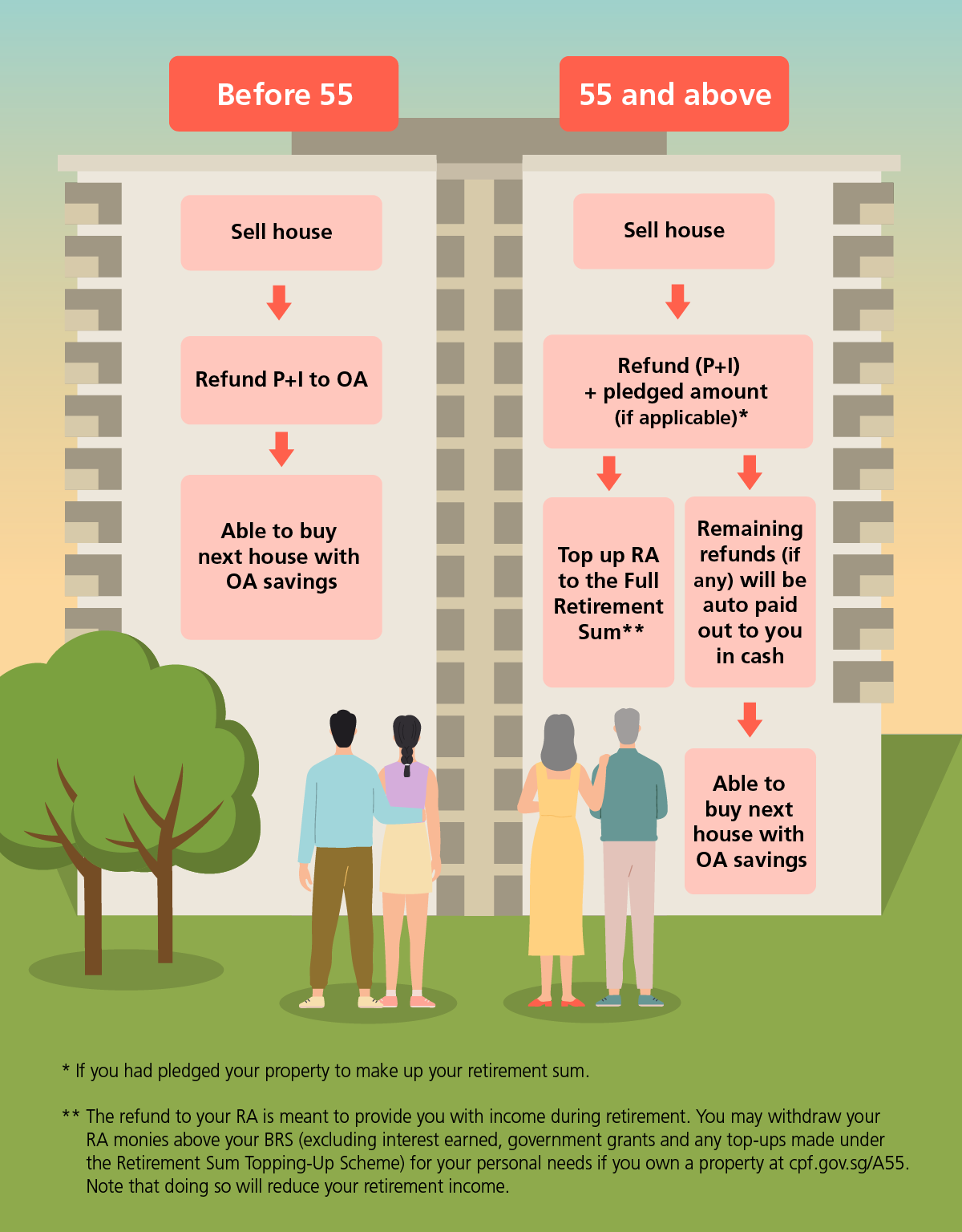
Upon selling your property, you will need to refund certain amounts to your CPF savings:
- The principal amount (P) you’ve withdrawn for the property.
- The accrued interest (I).
- If you pledged the property to meet your Full Retirement Sum (FRS), this amount will also need to be refunded along with P+I.
CPF savings are primarily for your retirement needs. Any CPF funds used for property reduce your available retirement funds. Therefore, all or part of the refunded amount will first be used to top up your Retirement Account (RA) to your FRS*. Any remaining balance will be paid to you in cash. You can also request to retain the balance housing refund in your CPF Account(s) if you prefer.
You can then reuse the Ordinary Account savings to purchase your next property, subject to applicable housing rules and limits.
However, housing limits set by CPF may apply. This safeguard prevents overspending on housing loan repayments at the expense of your retirement savings. Consider keeping some savings in CPF to earn attractive interest rates and boost your monthly payouts in retirement. 📊
Can I Still Use CPF for Monthly Mortgage Instalments? 🏠
When you turn 55, savings from your SA (followed by OA) will be transferred to create your RA, up to the FRS. Any balance remaining in your OA can still be used for your housing loan repayments. If you continue working after 55, you can use your monthly OA contributions to service your mortgage, even if you haven’t met your applicable Retirement Sum. 🛠️
However, housing limits set by CPF may apply. This measure safeguards against overspending on housing loan repayments at the expense of your retirement savings. It’s wise to consider keeping some savings in CPF to earn attractive interest rates and boost your monthly payouts in retirement.
If you need to continue using your OA for housing payments after age 55, you can apply to reserve your OA savings for this purpose before they are transferred to your RA. Do note, however, that when you start your monthly payouts (between ages 65 and 70), your reserved OA savings will be transferred to your RA if you have not met your FRS. 🎯

“Hi, I’m CS Tee (MySgProp.com), CEA licensed real estate advisor in Singapore since 2012. On top of Buy/ Sell/ Rent for Singapore property, we’re also market new launches for developers in various countries, i.e Malaysia, Indonesia, Thailand, Vietnam, Cambodia, UK, Australia and Dubai. If you or your friends need assistance with housing, feel free to refer them to us. We offer a generous referral fee as a token of our appreciation!”